Degrees, no jobs: The struggles of Jamaican graduates in today’s job market
Article By: Adenike Williams
-

- Apr 25, 2026 08:54 AM | News
-
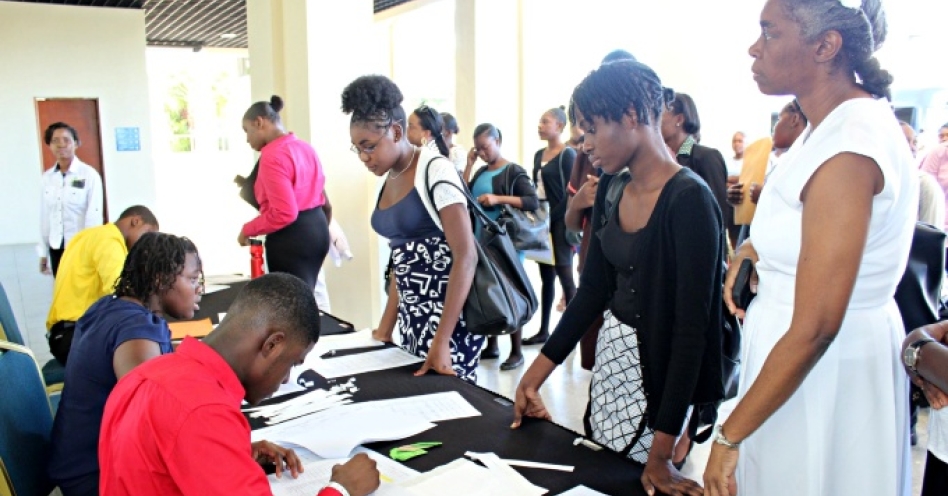
Job seekers at a 2019 Ministry of Labour job fair (Image Credit: facebook.com/ministryoflabourjamaica)
A 2025 Ministry of Health job fair had nearly 10,000 applicants, many of them students and recent graduates, who had to compete for just 600 available job positions, highlighting the growing gap between job seekers and available opportunities. Research indicates that many graduates remain unemployed for up to a year after completing their studies.
Despite being qualified and, in many cases, some experienced through internships, graduates report sending multiple applications daily with little to no response. For these graduates, the issue is not education but opportunity and access.
Makhalia Spaulding, a history and journalism graduate from the University of the West Indies, stated that she had applied to 15 jobs every day until receiving a call from one radio station, where she was interviewed. They then informed her that she needed more experience.
"As a recent graduate, it was weird and heartbreaking. Where can I find this experience? They could have given it to me,” she tells Old Harbour News.
Her situation is not unique as it reflects concern. As one graduate from the University of Technology in Jamaica who requested anonymity and who we will call John Brown said, “They are asking for five years’ worth of experience in roles meant for recent graduates.” Yet another whom we will call Pam Green asked, “But how are you supposed to get that experience if no one gives you a start?”
Additionally, internships and academic training, they say, are often dismissed by employers, forcing graduates initially to start over. At the same time, job listings often fail to disclose salaries, and when they do, compensation is often uncompetitive, a concern raised by University of the West Indies graduate Reajean Bennett.
"Even after attending university and earning a degree, you still have to settle for the bare minimum," a graduate from the University of Technology stated. “There are jobs, but not the kind that match what we studied for.”
With limited entry-level opportunities, along with increasing job demands, many are forced to turn to fields outside their area of study. One such career is teaching. Some individuals are pursuing teaching not out of passion, but out of necessity. This trend, some warn, will have wider implications for the education system, as individuals take on classroom roles for job security rather than long-term commitment. In cases like these, teachers often leave once a better opportunity arises.
The impact extends beyond employment. The graduates describe a cycle of anticipation, an increasing poverty threshold, growing frustration, declining confidence, and mental strain as they navigate constant rejection or, in many cases, silence.
“Every application you submit without receiving a response diminishes your confidence,” one graduate explained.
The burden expands beyond graduates. After years of financing their children’s education, parents now watch their children sit at home, an outcome that feels like a waste. Nickeisha Sharpe, a single mother of a recent graduate from the University of the West Indies, says her daughter’s unemployment is setting her back.
“Instead of becoming independent, she is still solely dependent on me,” Sharpe stated.
For this single mother, it is almost as if she’s sending her daughter back to school. She understands and acknowledges the emotional toll it may have on her child.
“It is even more stressful for her,” she added. “After spending her entire life in school, graduating and earning that degree, no one wants to hire you.”
In addition to the emotional strain, the financial burden is pressing. These graduates face additional financial challenges, from having to repay student loans as well as other loans used to cushion their educational journey to not being able to support their everyday needs and desires. In response, many graduates are finding alternate ways to cope with unemployment.
Boland, who prefers to be identified by her last name, graduated from the University of the West Indies Global Campus a year ago, says she’s only managing because of the supportive family she has. She’s also able to lean on her friends, she tells me, as they are all facing the same struggle: unemployment.
“On days that feel too heavy, I have a good cry, write my emotions down, and burn the paper. I use that to release all the negative energy,” she said.
While graduates continue to find ways to cope with the growing plague of unemployment, many are questioning the purpose of a degree. Behind every unanswered application is a young professional ready to contribute to the job market. As Jamaica continues to produce qualified graduates, the gap between education and employment is becoming harder to ignore. The question is no longer whether they are prepared or even qualified to work but if the system is prepared to give them a chance.