Jamaica hailed as regional model against fisheries crime
Article By: Old Harbour News
-

- Jul 31, 2026 08:39 AM | Agriculture, News
-
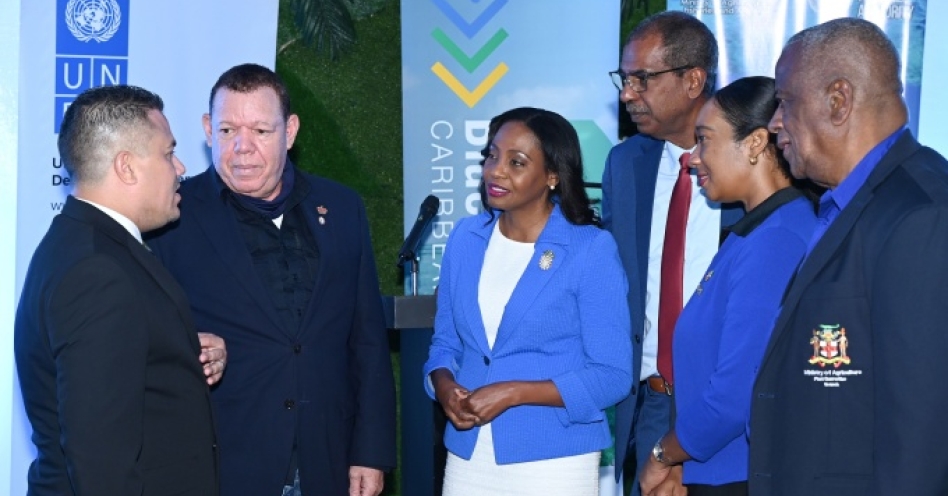
Right after the screening of the Blue Justice short film ‘Taking Back Our Oceans’, Minister of Water, Environment and Climate Change, Matthew Samuda has a chat with (from right), Minister of State in the Ministry of Agriculture, Fisheries and Mining, Honourable Franklin Witter, UNDP Assistant Resident Representative, Lesley-Ann Ennevor; CEO, National Fisheries Authority Dr Gavin Bellamy; Ambassador Shorna-Kay Richards, Undersecretary, Multilateral Affairs, Ministry of Foreign Affairs and Foreign Trade and former Ambassador to Japan; Richard King, National Fisheries Authority Board Member.
The system, established under the Blue Justice International Tracking Center, is providing regional governments with real-time, actionable data that is proving critical for intercepting illicit vessels and safeguarding marine resources.
“The establishment of the Blue Justice International Tracking Center, together with the secure government-to-government digital platform, has proven to be very, very transformative,” declared Minister of State in the Ministry of Agriculture, Fisheries and Mining, Franklin Witter.
Minister Witter, speaking at the recent Caribbean premiere of the Norwegian-produced short film ‘Taking Back Our Oceans’, emphasized that the technology is not just a tool for enforcement but a lifeline. “In times of disaster, it becomes nothing short of a lifeline,” he stated.
The film, which takes a deep dive into the regional and global fight against fisheries crime, features prominent regional voices including Minister of Agriculture, Fisheries and Mining, Floyd Green; National Fisheries Authority (NFA) CEO Dr. Gavin Bellamy; and former St. Vincent and the Grenadines Minister Saboto Ceasar. The documentary highlights the growing threat of organized crime networks that exploit fisheries, often with links to drug trafficking and human rights abuses.
A ‘Caribbean Model’ Adopted Internationally
The success of the Jamaica-led Blue Justice Caribbean Hub — launched in 2023 and housed within the NFA — has been so pronounced that other nations are now looking to replicate its structure.
Dr. Gavin Bellamy reported that the West African island nation of Cabo Verde has drawn direct inspiration from the Jamaican and Caribbean experience. “Through the Blue Justice — the Blue Resilience Project, the Blue Justice Caribbean Hub, and Jamaica's multi-agency mechanism template – we have demonstrated the value of this collaborative approach which has been shared and adopted in the region,” Dr. Bellamy noted.
He confirmed that discussions in Cabo Verde regarding the strengthening of inter-agency cooperation have been significantly informed by Jamaica’s model of shared data and coordinated intelligence.
Multi-Agency Approach and UNDP Support
The initiative is supported by the United Nations Development Programme’s (UNDP) Blue Resilience project, financed by the Government of Norway. The project has supported Jamaica in establishing a Multi-Agency Mechanism that brings together fisheries authorities, the coast guard, and law enforcement to enhance governance and compliance.
UNDP Assistant Resident Representative Lesley-Ann Ennevor praised the collaborative framework. “Through joint training, improved coordination, and the use of innovative tools such as secure digital platforms, agencies are better equipped to address illegal fishing and related crimes across the supply chain,” she said.
Echoing the urgency of the threat, Minister of Water, Environment and Climate Change, Matthew Samuda, acknowledged that Jamaica has been “raided of its fish stock far more than we realized”. He highlighted ongoing investments in the Coast Guard and the declaration of increased marine protected areas as key to replenishing the region’s pelagic stock.
“We cannot confront transnational organized crime in fisheries in isolation,” Minister Witter concluded. “We need shared data. We need coordinated intelligence, and critically, we need equity in access to the technology.”